
Education & Teaching
Letters to Numbers Activities for the Classroom
Converting letters to numbers is one of the most versatile cross-curricular tools a teacher can use. A simple letters to numbers converter bridges the gap between literacy and numeracy, turning spelling words into math problems, vocabulary drills into puzzle games, and reading comprehension into detective work. This article presents ten classroom-tested activities organized by difficulty level, complete with learning objectives, materials lists, and adaptation tips for different age groups.
Why Letter-Number Activities Work
The A1Z26 system (A=1, B=2, C=3, through Z=26) is intuitive enough for first-graders yet rich enough to challenge fifth-graders. It works because it sits at the intersection of two fundamental skill sets children are developing simultaneously: alphabet knowledge and number sense. When a student converts the word "CAT" to 3-1-20 and adds them to get 24, they are practicing letter identification, ordinal counting, and addition in a single exercise.
Research in educational psychology supports multi-modal learning: when students process information through multiple channels (verbal and mathematical), retention improves. Letter-number conversion naturally creates this dual-coding effect.
Activity 1: Spelling Word Values
Grade level: 1-3 | Time: 20 minutes | Skills: Addition, spelling
Give students their weekly spelling list and challenge them to find the "value" of each word by converting letters to numbers and adding them up. Which spelling word is worth the most? Which is worth the least? Can they find two words with the same value?
Learning objectives: Practice addition with multiple addends. Reinforce spelling word recognition. Introduce the concept of a mathematical function (same input always produces the same output).
Extension: Older students can predict which words will have higher values based on letter composition (words with letters late in the alphabet like W, X, Y, Z score higher) before calculating.
Activity 2: Code-Breaking Scavenger Hunt
Grade level: 2-5 | Time: 30-45 minutes | Skills: Decoding, reading comprehension, spatial reasoning
Hide coded clues around the classroom or school. Each clue is a message encoded in A1Z26 numbers that, when decoded, tells students where to find the next clue. The final clue leads to a prize or reveals a secret message.
Example clue:12-15-15-11 / 21-14-4-5-18 / 20-8-5 / 20-5-1-3-8-5-18-19 / 4-5-19-11 (Decoded: "LOOK UNDER THE TEACHERS DESK")
Learning objectives: Decode letter-number ciphers fluently. Follow multi-step instructions. Work collaboratively in teams.
Download ready-to-use scavenger hunt templates from our printable worksheets page.
Activity 3: Secret Message Journal
Grade level: 2-4 | Time: 15 minutes daily | Skills: Writing, encoding, decoding
Students keep a daily journal where they write one sentence in coded numbers. The next day, they swap journals with a partner who decodes the message. This builds consistent practice over time and develops both encoding and decoding fluency.
Learning objectives: Practice encoding and decoding daily. Develop writing fluency through low-pressure journaling. Build peer relationships through shared secret communications.
Activity 4: Word Value Olympics
Grade level: 3-5 | Time: 25 minutes | Skills: Addition, strategic thinking, vocabulary
Challenge students to find the highest-value word they can think of within a given category (animals, foods, countries). Each letter's position value is added up. Students compete individually or in teams to find the champion word in each category.
Sample round — Animals: CAT = 3+1+20 = 24. ZEBRA = 26+5+2+18+1 = 52. BUTTERFLY = 2+21+20+20+5+18+6+12+25 = 129. Students quickly discover that longer words with late-alphabet letters win.
Learning objectives: Practice multi-digit addition. Expand vocabulary within categories. Develop strategic thinking (choosing letters toward the end of the alphabet).
Activity 5: Math-Literacy Crossover Puzzles
Grade level: 3-6 | Time: 20 minutes | Skills: Algebra foundations, logic, vocabulary
Present equations where letters represent their number values: "C + A + T = ?" (3+1+20=24). Then reverse it: "? + ? + ? = 24. What three-letter word could this be?" Students must find words whose letter values sum to a target number. This introduces algebraic thinking naturally.
Learning objectives: Solve for unknowns in an engaging context. Explore multiple solutions to the same problem. Connect algebraic thinking to language.
For reference, students can use the printable alphabet chartshowing each letter's position.
Activity 6: Cipher Comparison Challenge
Grade level: 4-7 | Time: 30 minutes | Skills: Pattern recognition, comparison, critical thinking
Introduce students to two different letter-number systems: standard A1Z26 (A=1, Z=26) and reverse alphabet (A=26, Z=1). Have them encode the same word in both systems and compare the results. Which system produces higher values for which letters? Can they figure out the mathematical relationship between the two? (Hint: for any letter, the A1Z26 value plus the reverse value always equals 27.)
Learning objectives: Compare and contrast encoding systems. Discover mathematical patterns and invariants. Practice subtraction and addition simultaneously.
Activity 7: Coded Reading Comprehension
Grade level: 2-5 | Time: 25 minutes | Skills: Reading comprehension, decoding, attention to detail
Replace key words in a reading passage with their number codes. Students must decode the numbers to fill in the blanks and understand the passage. For example: "The 3-1-20 sat on the 13-1-20" (The CAT sat on the MAT).
Learning objectives: Practice decoding in context. Use contextual clues to predict words before fully decoding. Build reading comprehension through active engagement.
This activity pairs perfectly with our secret codes for kids resource, which introduces the concept of letter-number codes in an age-appropriate way.
Activity 8: Coordinate Grid Spelling
Grade level: 4-6 | Time: 25 minutes | Skills: Coordinate graphing, spatial reasoning, spelling
Students plot their spelling words on a coordinate grid where the x-axis represents the letter position in the word (1st letter, 2nd letter, etc.) and the y-axis represents the letter's number value. The word "CAT" would plot as points (1,3), (2,1), (3,20). Connect the dots to create a unique shape for each word. Students can then recognize words by their shape patterns.
Learning objectives: Practice plotting coordinates. Visualize words as mathematical shapes. Connect spatial reasoning to literacy.
Activity 9: Coded Story Writing
Grade level: 3-6 | Time: 40 minutes | Skills: Creative writing, encoding, revision
Students write a short story (3-5 sentences) in plain English, then encode the entire story in numbers. They swap with a partner, who must decode and read the story. The writer checks the decoded version against their original to catch any errors.
Learning objectives: Practice extended encoding and decoding. Develop attention to detail through error-checking. Build creative writing and storytelling skills.
Differentiation: Struggling students encode only the key nouns and verbs. Advanced students encode the full story and add a Caesar shift of 3 for extra difficulty.
Activity 10: Historical Cipher Day
Grade level: 5-8 | Time: 45-60 minutes (full period) | Skills: History, critical thinking, teamwork
Organize a full-period activity around historical ciphers. Students rotate through stations covering different historical cipher systems: the Caesar shift (ancient Rome), the Polybius square (ancient Greece), the A1Z26 substitution (modern), and simple transposition ciphers. Each station has a historical fact sheet and a coded message to decode.
Learning objectives: Understand the historical context of cryptography. Compare different encoding approaches. Work collaboratively under time pressure. Connect STEM concepts to social studies.
Assessment Ideas
Letter-number activities create natural assessment opportunities beyond traditional tests.
- Exit tickets: Give students a 5-number code to decode before leaving class. Correct decoding = mastery.
- Portfolio pieces: Students select their best coded story or highest-value word competition entry for their portfolio.
- Peer assessment: Partners check each other's encoding work, developing both encoding accuracy and error-detection skills.
- Speed drills: Time how quickly students can encode or decode a 10-letter word. Track improvement over weeks.
- Self-assessment journals: Students rate their confidence with encoding and decoding on a 1-5 scale each week.
Tips for Implementation
- Start with the reference chart: Post an A-Z = 1-26 chart on the classroom wall. Students will memorize common values naturally over time.
- Use digital tools: Let students verify their hand-calculated codes using an online converter. This builds digital literacy and teaches self-checking habits.
- Differentiate naturally: These activities self-differentiate. Struggling students work with shorter words and simpler addition. Advanced students tackle longer words, multiple cipher systems, and word-value comparisons.
- Connect to standards: Map each activity to your specific curriculum standards (Common Core, state standards, IB PYP) when documenting lesson plans.
- Celebrate achievements: Create a "Codebreaker of the Week" award. Display the highest-value word on a classroom leaderboard.
Free classroom tools: Visit our Worksheets page for printable letter-number conversion activities, or use the online converter on your classroom smartboard for live demonstrations.
Frequently Asked Questions
What age group is letters to numbers coding best suited for?
Basic A1Z26 activities work for children ages 6-7 who know the alphabet, while advanced cipher activities challenge students through middle school. The beauty of letter-number conversion is its scalability. First and second graders can encode and decode simple three-letter words with teacher support. Third through fifth graders handle full sentences, word value calculations, and scavenger hunts independently. Sixth through eighth graders can compare cipher systems, explore the mathematics behind them, and tackle historical cryptography projects.
How does letters to numbers coding support math curriculum goals?
Letter-number activities reinforce addition, subtraction, multiplication, ordering, comparing, and algebraic thinking within an engaging, cross-curricular context. Calculating word values practices multi-addend addition. Comparing two cipher systems exercises subtraction and inverse operations. The skip code (multiply position by a constant) practices multiplication tables. Finding words that sum to a target number introduces algebraic reasoning. All of this happens in a motivating context where students are solving puzzles rather than completing drill sheets.
Can I use these activities for remote or hybrid learning?
Yes, most activities adapt easily to remote settings using free online converters and video conferencing tools.Students can encode messages at home and share coded messages through chat for classmates to decode. Scavenger hunts become "decode the clue to find the hidden object in your house." Word Value Olympics can run asynchronously with students posting their best words to a shared document. The key advantage is that an online letter-number converter provides instant verification, so students get immediate feedback without teacher intervention.
Are there printable worksheets available?
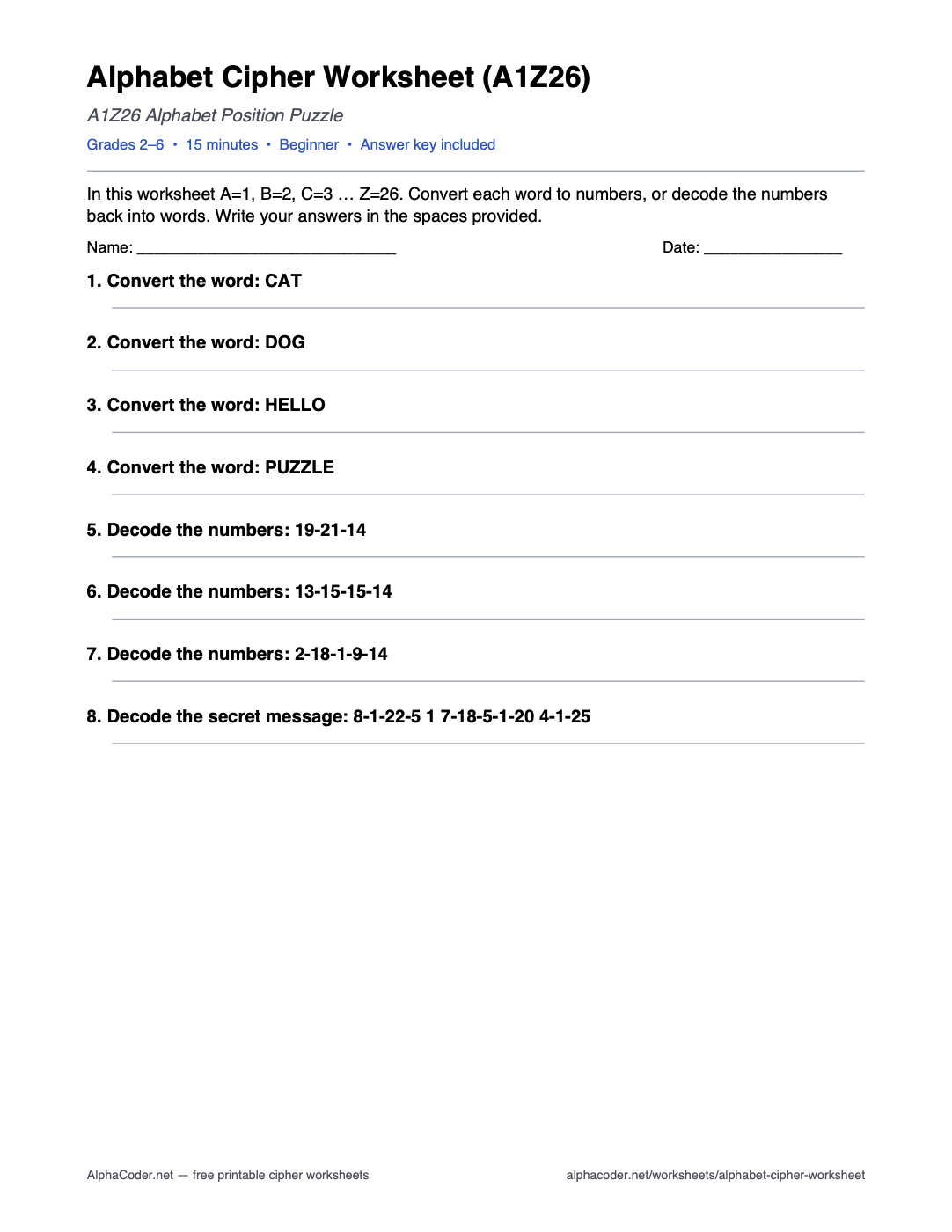
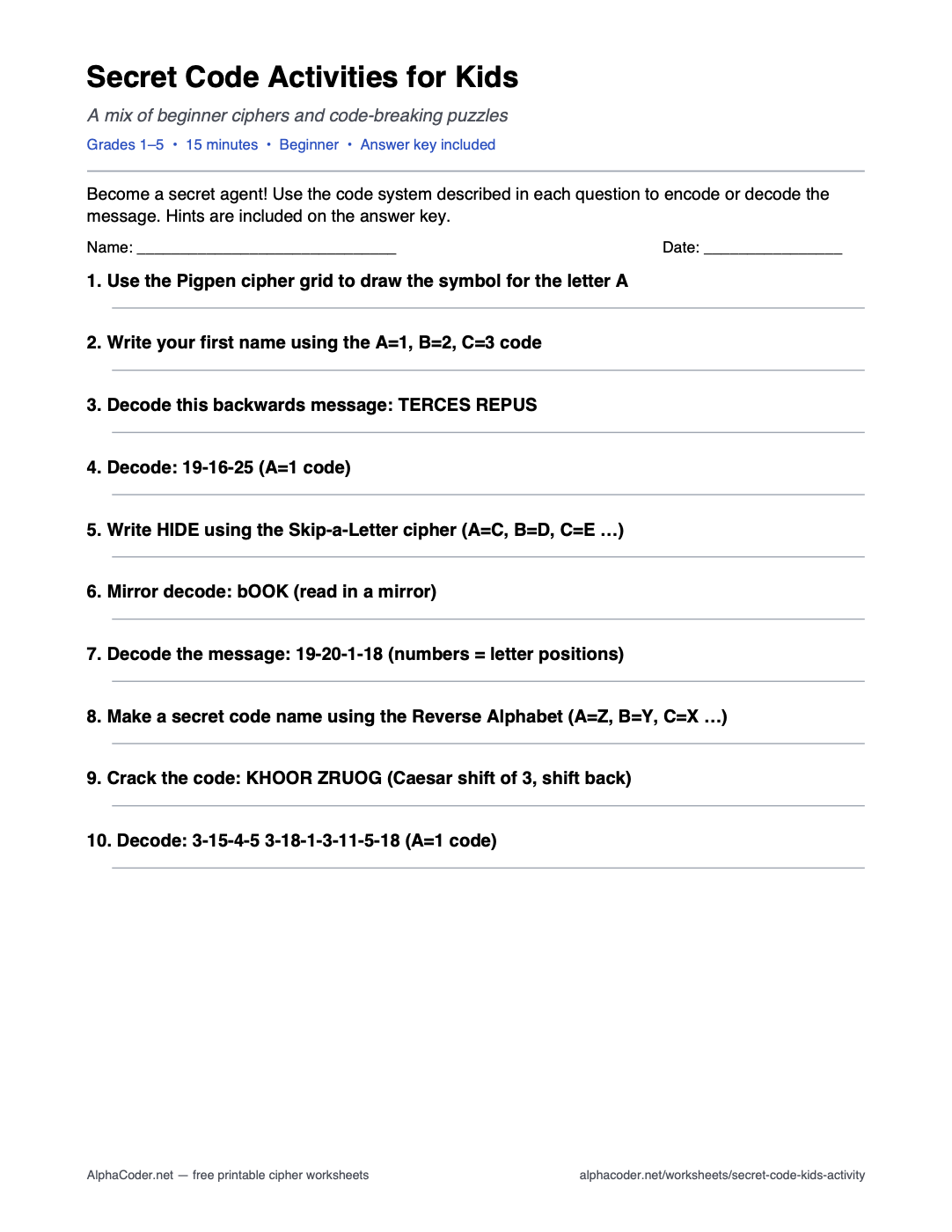
Yes, AlphaCoder provides free printable worksheets with encoding practice, decoding challenges, and cipher wheel templates. The worksheet collection includes graded exercises from beginner (three-letter words) to advanced (full sentence decoding), plus blank cipher wheels that students can cut out and assemble. All worksheets are free to download and photocopy for classroom use. Visit the worksheets section for the complete collection.
Ready-to-print worksheets for your classroom
Grab a ready-to-print PDF with a matching answer key — no signup needed.
Written by Jack Shi. AlphaCoder tools process every conversion locally in your browser.