Escape Rooms
Escape Room Ciphers — Complete Code Guide
Escape rooms are timed puzzle experiences where teams must solve a series of challenges to "escape" before the clock runs out. Ciphers and codes are among the most common puzzle types, appearing in everything from beginner-friendly family rooms to expert-level competitive challenges. Knowing how to quickly identify and decode common cipher types can shave minutes off your solve time.
This guide covers every major cipher type used in escape rooms, teaches you how to recognize each one on sight, and provides step-by-step decoding strategies.
The A1Z26 Number Substitution
The most frequently used cipher in escape rooms. Each letter is replaced by its alphabet position number (A=1, B=2, Z=26). It appears on walls, inside books, on blacklight-revealed messages, and as combination lock hints.
Recognition: A sequence of numbers from 1 to 26, often grouped or separated by dashes, spaces, or commas.
Common escape room use: The decoded word is a clue (like "LOCKER" or "DRAWER"), or the decoded numbers are entered as a combination (BEAD = 2-5-1-4 = combination 2514).
Speed tip: Memorize anchor letters. E=5, J=10, M=13 (middle), P=16, T=20. Count from the nearest anchor.
Practice with the A1Z26 converter
The Caesar Cipher (Letter Shift)
Each letter in the message has been shifted by a fixed number of positions. A shift of 3 turns A into D, B into E, and so on. The shift amount might be hidden elsewhere in the room as a clue.
Recognition: Text that looks like scrambled English. Word lengths and spaces are preserved, which distinguishes it from random characters.
Decoding strategy: Look for common short words. If you see a three-letter word starting with "wkh", try shifting back 3 to get "the". Common words to spot: THE, AND, FOR, WAS.
Speed tip: Try ROT13 first. It is the most common shift value in escape rooms because it is easy for designers to implement and verify.
Test all 25 shift values at once
The Pigpen Cipher (Freemason Cipher)
One of the most visually distinctive ciphers in escape rooms. Letters are replaced by geometric symbols derived from two tic-tac-toe grids (one plain, one with dots). The shape of each symbol corresponds to the portion of the grid where its letter sits.
Recognition: Angular symbols made of lines and corners, some with dots in the center. They look like fragments of a grid.
Decoding strategy: You need the pigpen grid key, which is sometimes hidden in the room. Without the key, look for a tic-tac-toe grid pattern drawn somewhere. The first grid (without dots) maps A-I using the nine cells, and the second grid (with dots) maps J-R. An X-shaped grid maps S-V and W-Z with dots.
Morse Code
Dots and dashes represent letters. In escape rooms, Morse code might appear as actual dots and dashes, as long and short lines, as flashing lights, as audio beeps, or as patterns of raised bumps on a surface.
Recognition: Two distinct types of marks or signals (short/long, light/heavy, raised/flat) arranged in groups separated by wider gaps.
Speed tip: Learn the most common letters first: E (dot), T (dash), A (dot-dash), N (dash-dot), I (dot-dot), S (dot-dot-dot).
Binary Code
Messages encoded in binary (0s and 1s). Each letter is represented by its A1Z26 position in 5-bit binary (A=00001, Z=11010) or its ASCII value in 8-bit binary (A=01000001).
Recognition: Sequences of only two symbols (0/1, on/off, black/white) in consistent group sizes of 5 or 8.
Decoding strategy: If groups are 5 digits, it is likely A1Z26 binary (convert to decimal, then to letter). If groups are 8 digits, it is likely ASCII binary.
The Polybius Square
Letters are placed in a 5x5 grid and represented by their row-column coordinates. Similar to the coordinate code for kids but with a formal name. Each letter becomes a two-digit number.
Recognition: Pairs of small numbers (11 through 55), often in a grid-like pattern or with a 5x5 grid posted nearby.
Decoding: The first digit is the row, the second is the column. Need to know which grid arrangement is used (standard alphabetical, or a keyword-shuffled variant).
Semaphore Flag Signals
Each letter is represented by a specific arm position, like a person holding two flags. In escape rooms, this might appear as drawings of stick figures, clock hands at specific positions, or directional arrows.
Recognition: Images of figures with arms at various angles, or pairs of directional indicators.
Color-Based Codes
Colors map to numbers or letters. Common systems include resistor color codes (black=0 through white=9), rainbow order (ROYGBIV = 1-7), or custom color-letter mappings defined by a key hidden in the room.
Recognition: A sequence of colored objects, lights, or marks with a matching color reference chart somewhere in the room.
How to Identify an Unknown Cipher
When you encounter a cipher you do not immediately recognize, follow this decision tree:
- Count unique characters: Only 2 types? Binary or Morse. 10 types (0-9)? Likely a number code. 26+ types? Substitution or transposition.
- Check for word spacing: Preserved spaces suggest a substitution cipher (Caesar, Atbash). No spaces suggest a different encoding system.
- Look at number ranges: Numbers 1-26? A1Z26. Numbers 65-122? ASCII. Pairs of numbers 11-55? Polybius square.
- Check for geometric symbols: Angular grid fragments = Pigpen. Stick figures with arms = Semaphore. Dot-dash patterns = Morse.
- When in doubt: Try A1Z26 first (it is the most common), then ROT13, then look for a key or reference chart hidden in the room.
Stuck on a cipher? Try our Cipher Identifier tool, which analyzes encoded text and suggests the most likely cipher type with confidence scores.
Speed-Solving Tips
- Divide and conquer: Assign one team member to decode while others search for the next clue.
- Use your phone: Most escape rooms allow phones for cipher tools. Bookmark AlphaCoder.net before you go.
- Look for the key first: Many escape rooms hide the cipher key in the room. Spend 30 seconds scanning for reference charts before trying to brute-force a solution.
- Write it down: Decode on paper, not in your head. Visual decoding catches errors faster.
- Guess common words: If you have decoded part of a message, guess the rest from context. "OPEN THE ___" probably ends with "DOOR" or "BOX."
Practice at Home
Build your cipher-solving speed before your next escape room visit:
- Encode a message with our A1Z26 tool and have a friend decode it by hand
- Practice the Caesar cipher with different shift values until you can recognize shifted English text on sight
- Learn to decode Morse code by ear using online audio trainers
- Create a mini escape room at home using printed ciphers and combination locks
Frequently Asked Questions
What is the hardest cipher type in escape rooms?
Multi-step ciphers that combine two or more systems are the most challenging. For example, a message might be first encoded with A1Z26, then the resulting numbers converted to Morse code. The Vigenere cipher is also considered difficult because it requires a keyword and does not respond to simple frequency analysis.
Should I memorize the entire Morse code alphabet?
Memorizing the full Morse alphabet is ideal but not necessary for escape rooms. Learn the most common letters (E, T, A, O, I, N, S, H, R) and bring a reference card or use a phone app for the rest. Pattern recognition improves with practice.
Do escape rooms ever use custom ciphers?
Yes. Some high-end escape rooms create custom symbol sets with a unique glyph for each letter. These always include a key or legend somewhere in the room. The solving method is the same as any substitution cipher: find the key, then translate symbol by symbol.
How can I improve my decoding speed?
Practice regularly with online cipher tools. Time yourself decoding A1Z26 sequences and aim to recognize common words without looking up each letter. Memorize anchor points (E=5, J=10, M=13, T=20, Z=26) so you can calculate any letter's position in under three seconds.
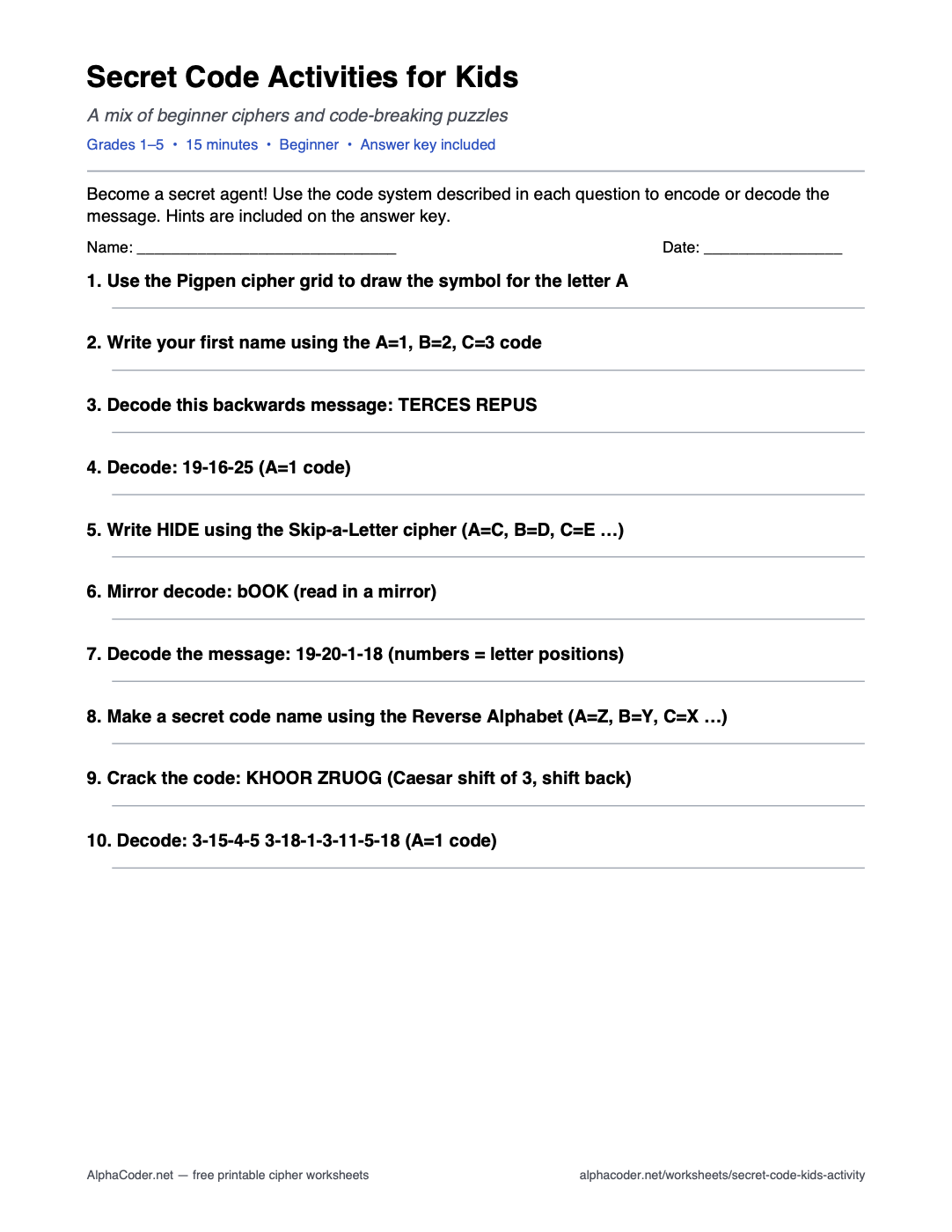
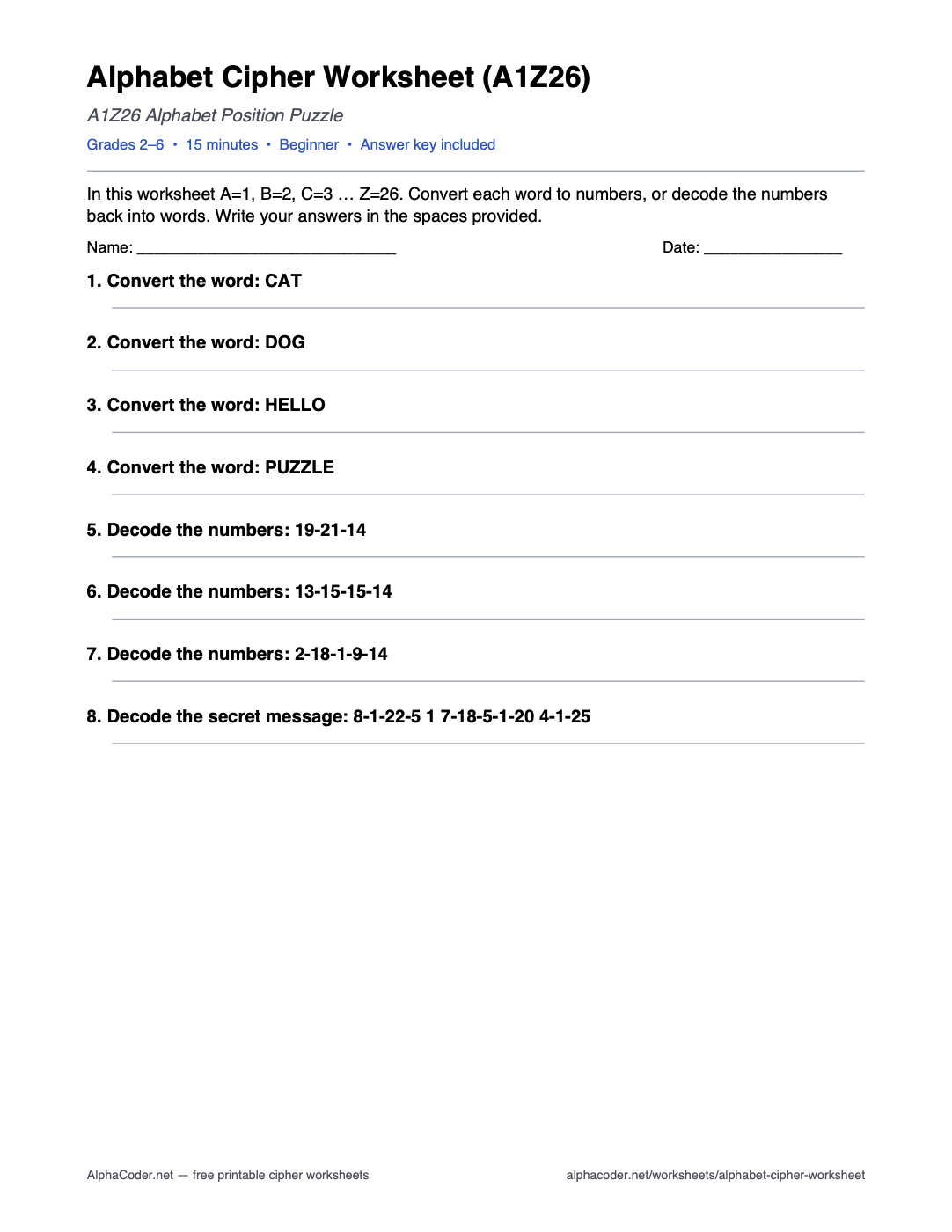
Practice with printable cipher worksheets
Grab a ready-to-print PDF with a matching answer key — no signup needed.
Written by Jack Shi. AlphaCoder tools process every conversion locally in your browser.