Comparison & Learning Path
Best Cipher for Beginners — A1Z26 vs Caesar vs Atbash
If you are new to cryptography and want to learn your first cipher, you are facing a classic beginner's question: where do I start? There are hundreds of cipher systems, but only a handful are suitable entry points. This guide ranks the four best beginner ciphers, walks through step-by-step examples of each, and provides a recommended learning path from absolute beginner to intermediate. Start with the letters to numbers converter to get hands-on experience with the simplest cipher before moving on to more complex systems.
Beginner Cipher Rankings
| Rank | Cipher | Difficulty | Type | Key Required? |
|---|---|---|---|---|
| 1 | A1Z26 | Very Easy | Encoding | No |
| 2 | Caesar | Easy | Encryption | Yes (shift number) |
| 3 | Atbash | Easy | Encryption | No (fixed rule) |
| 4 | Vigenere | Moderate | Encryption | Yes (keyword) |
#1: A1Z26 — The Perfect Starting Point
Difficulty: 1/5 | Type: Encoding | Age: 6+
The A1Z26 system assigns each letter its position in the alphabet: A=1, B=2, C=3, all the way to Z=26. It is technically an encoding rather than a cipher because there is no secret key. Anyone who knows the alphabet can decode it. But it is the perfect starting point because it introduces the fundamental concept underlying all ciphers: systematic letter-to-number (or letter-to-letter) substitution.
Step-by-Step Example: Encoding "SECRET"
- S is the 19th letter → 19
- E is the 5th letter → 5
- C is the 3rd letter → 3
- R is the 18th letter → 18
- E is the 5th letter → 5
- T is the 20th letter → 20
Result: 19-5-3-18-5-20
Why Start Here?
- No math beyond counting is required
- The pattern is immediately intuitive
- It builds the letter-position awareness needed for all subsequent ciphers
- You can encode and decode messages in your head with practice
- Mistakes are easy to catch and correct
Limitation
A1Z26 is not secure. It provides no confidentiality because the mapping is universally known. Think of it as training wheels: essential for learning, but not meant for real-world security.
#2: Caesar Cipher — Your First Real Cipher
Difficulty: 2/5 | Type: Symmetric encryption | Age: 8+
The Caesar cipheris the simplest true encryption system. Named after Julius Caesar, who reportedly used a shift of 3 for military communications, it works by shifting each letter forward (or backward) in the alphabet by a fixed number of positions. The shift value is the "key."
Step-by-Step Example: Encoding "SECRET" with Shift 3
- S + 3 positions → V
- E + 3 positions → H
- C + 3 positions → F
- R + 3 positions → U
- E + 3 positions → H
- T + 3 positions → W
Result: VHFUHW
To decode, shift each letter backward by 3: V-3=S, H-3=E, F-3=C, and so on.
What Caesar Teaches You
- The concept of a key: You need the shift number to decode. Without it, you must try all 25 possibilities (brute force).
- Modular arithmetic: What happens when you shift Z by 3? It wraps around to C. This wrapping is modular arithmetic (mod 26).
- The difference between encoding and encryption: Unlike A1Z26, Caesar requires knowing the key to decode. That makes it encryption.
Limitation
Only 25 possible keys (shifts 1-25, since shift 0 and shift 26 leave the text unchanged). An attacker can try all 25 in seconds. This is called a brute-force attack and is the first concept in cryptanalysis.
#3: Atbash Cipher — The Mirror Alphabet
Difficulty: 2/5 | Type: Fixed substitution | Age: 8+
The Atbash cipher reverses the alphabet: A becomes Z, B becomes Y, C becomes X, and so on. Originally used in Hebrew texts (its name comes from the Hebrew letters Aleph-Tav-Beth-Shin), it is one of the oldest known substitution ciphers.
The Atbash Substitution Table
| Plain | A | B | C | D | E | ... | V | W | X | Y | Z |
|---|---|---|---|---|---|---|---|---|---|---|---|
| Cipher | Z | Y | X | W | V | ... | E | D | C | B | A |
Step-by-Step Example: Encoding "SECRET"
- S (19th) → H (8th, since 27-19=8)
- E (5th) → V (22nd, since 27-5=22)
- C (3rd) → X (24th, since 27-3=24)
- R (18th) → I (9th, since 27-18=9)
- E (5th) → V (22nd)
- T (20th) → G (7th, since 27-20=7)
Result: HVXIVG
What Atbash Teaches You
- Self-reciprocal ciphers: Encoding and decoding use the same operation. Apply Atbash twice and you get the original text back.
- Mathematical formula: The cipher position = 27 minus the plain position. This is a clean, elegant rule.
- Fixed substitution weakness: Atbash has exactly one possible key (the reversed alphabet), making it even easier to break than Caesar.
#4: Vigenere Cipher — The Next Level
Difficulty: 3/5 | Type: Polyalphabetic encryption | Age: 10+
The Vigenere cipheruses a keyword to determine different shift values for each letter. If your keyword is "KEY," the first letter shifts by 10 (K=11th letter, but shift by K's position minus 1 or by position itself depending on convention; the standard convention uses K=10, E=4, Y=24). The second letter shifts by 4, the third by 24, then the pattern repeats.
Step-by-Step Example: Encoding "SECRET" with Key "KEY"
| Plain letter | S | E | C | R | E | T |
|---|---|---|---|---|---|---|
| Key letter | K | E | Y | K | E | Y |
| Shift (0-indexed) | 10 | 4 | 24 | 10 | 4 | 24 |
| Cipher letter | C | I | A | B | I | R |
Result: CIABIR
What Vigenere Teaches You
- Polyalphabetic substitution: Different letters get different shifts, defeating simple frequency analysis.
- Keyword-based keys: The key is a word, not a single number. This dramatically increases the key space.
- The concept of key length: Security depends heavily on the length and unpredictability of the keyword.
Recommended Learning Path
Follow this progression from absolute beginner to intermediate cryptographer. Each level builds on skills from the previous one.
- Week 1-2: A1Z26. Practice encoding and decoding messages by hand. Build speed. Memorize common letter positions (E=5, T=20, A=1, S=19). Use the online converter to check your work.
- Week 3-4: Caesar Cipher. Start with small shifts (1-3). Practice wrapping around the alphabet (X+3=A). Try all 25 shifts to brute-force a message. Learn what "frequency analysis" means.
- Week 5-6: Atbash Cipher. Master the reversal pattern. Notice that Atbash is self-reciprocal. Compare Atbash output to Caesar output and understand why fixed substitution is weak.
- Week 7-8: Vigenere Cipher. Start with short keywords (3 letters). Work up to longer keywords. Understand why longer keywords are harder to crack. Research the Kasiski examination (the method that broke Vigenere).
- Beyond: Modern cryptography. Study how AES, RSA, and hash functions work at a conceptual level. Understand why modern ciphers use mathematical operations far beyond simple letter shifting.
Comparison: All Four Ciphers Applied to "HELLO"
| Cipher | Key/Rule | "HELLO" Encoded |
|---|---|---|
| A1Z26 | Position | 8-5-12-12-15 |
| Caesar (shift 3) | 3 | KHOOR |
| Atbash | Reverse | SVOOL |
| Vigenere | KEY | RIJVS |
Notice how each cipher produces a completely different output from the same input. A1Z26 converts to numbers, while the other three convert letters to different letters. Caesar and Atbash are monoalphabetic (each letter always maps to the same substitute), while Vigenere is polyalphabetic (the same letter can map to different substitutes depending on its position relative to the keyword).
Resources for Learning More
- Interactive tools: Practice with our free online converters for each cipher system.
- Printable worksheets: Download practice sheets from the worksheets section for offline study.
- Historical context: Read the history of ciphers article to understand how these systems evolved and why they were eventually superseded.
- Puzzle communities: Join geocaching, escape room design, or CTF (Capture the Flag) communities to practice ciphers in real challenge scenarios.
Start learning now: Open the A1Z26 Converter and encode your first message. Then try the Caesar Cipher with the same message. Compare the results and see the difference between encoding and encryption firsthand.
Frequently Asked Questions
What is the easiest cipher to learn?
The A1Z26 cipher is the easiest to learn because it simply maps each letter to its alphabet position: A=1, B=2, through Z=26. There are no mathematical operations, no keys, and no complex rules. If you know the order of the alphabet, you already know A1Z26. It requires only counting, and most people can encode short words mentally within seconds after minimal practice. Every other cipher system builds on the letter-position awareness that A1Z26 develops.
What order should I learn ciphers in?
The recommended order is A1Z26, then Caesar, then Atbash, then Vigenere, as each builds on concepts from the previous one. A1Z26 teaches letter-number mapping, the foundational skill. Caesar introduces the concept of a key (the shift value) and modular arithmetic. Atbash teaches reversal and self-reciprocal systems. Vigenere combines multiple shifts with a keyword, introducing polyalphabetic substitution. This progression mirrors the historical development of cryptography and creates a smooth difficulty ramp.
Is the Caesar cipher still used today?
Not for actual security, but it is widely used in education, puzzles, and informal text obfuscation like ROT13. With only 25 possible keys, the Caesar cipher can be broken by brute force in seconds. However, it remains the most popular teaching tool for introducing encryption concepts to beginners. The ROT13 variant (shift of 13) is used online to hide spoilers and punchlines, since applying ROT13 twice returns the original text. Understanding Caesar is also a prerequisite for understanding more complex ciphers.
What is the difference between A1Z26 and Caesar cipher?
A1Z26 converts letters to position numbers (A=1, B=2) with no key required, while Caesar shifts letters to other letters using a secret shift value.A1Z26 is an encoding: it changes the format (letters to numbers) and anyone can decode it. Caesar is an encryption: it substitutes letters with other letters, and you need the shift key to decode. "HELLO" in A1Z26 becomes "8-5-12-12-15" (numbers). "HELLO" in Caesar with shift 3 becomes "KHOOR" (still letters, but different ones). They serve different purposes and operate on different principles.
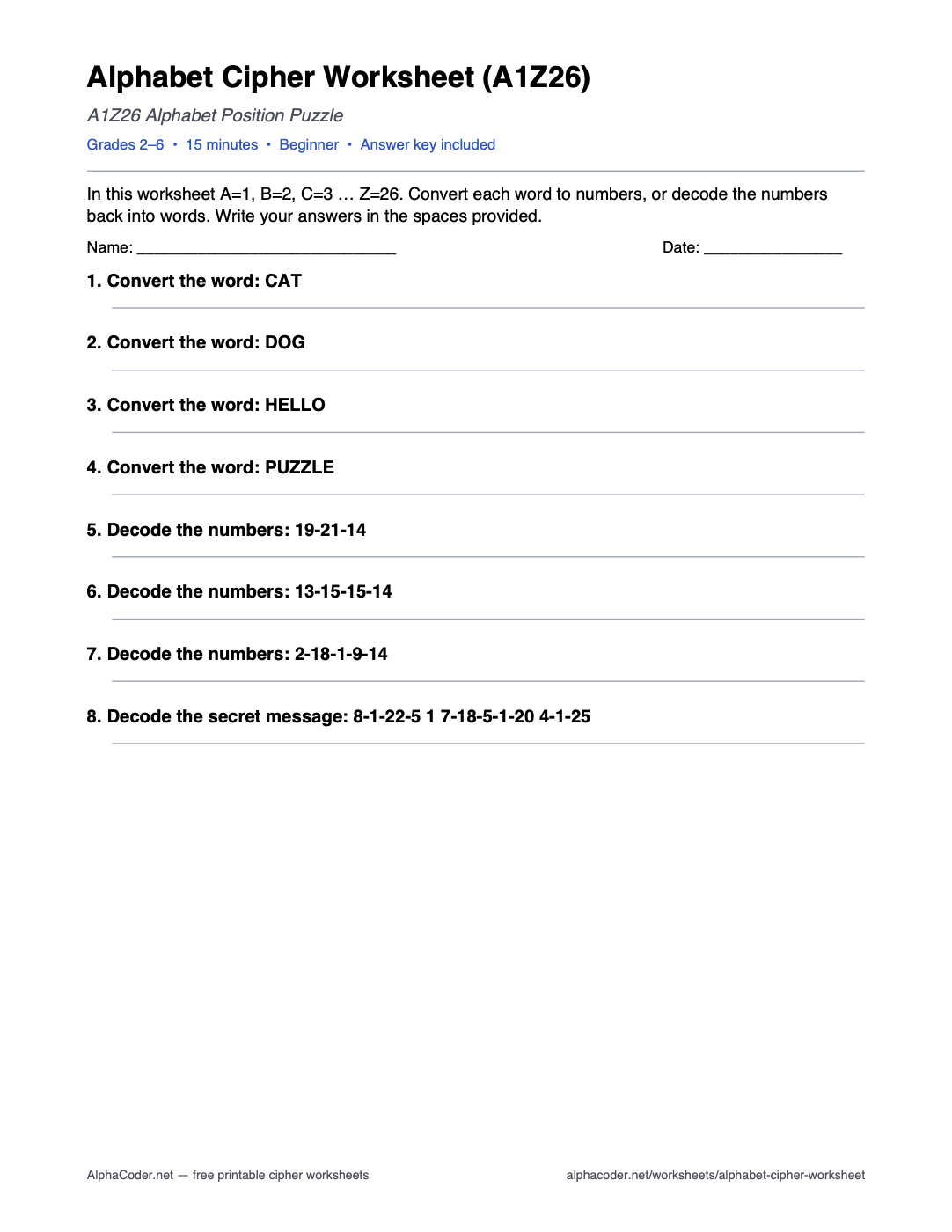
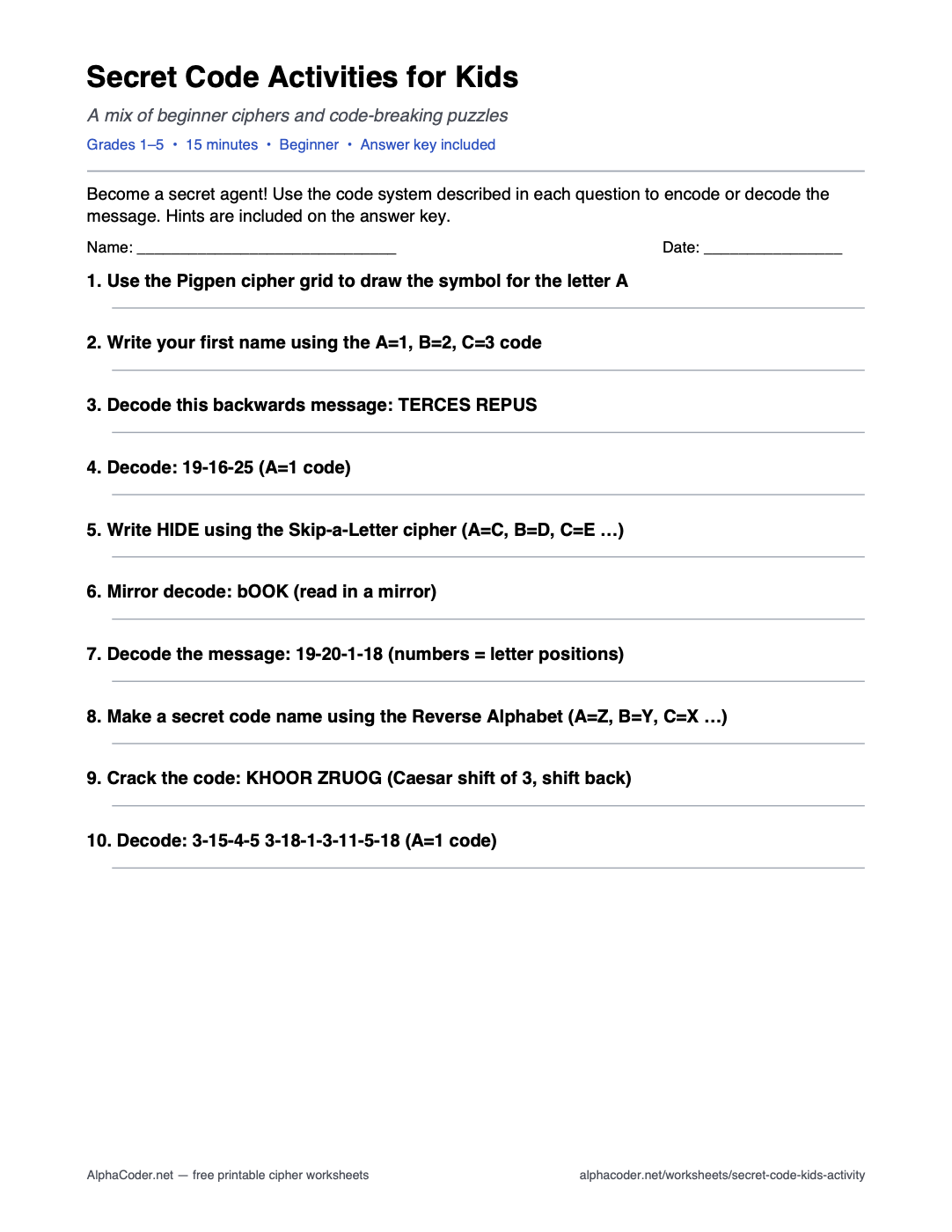
Start with a printable beginner worksheet
Grab a ready-to-print PDF with a matching answer key — no signup needed.
Written by Jack Shi. AlphaCoder tools process every conversion locally in your browser.