Complete Reference
Alphabet Position of Every Letter — Complete A to Z List
Every letter in the English alphabet has a fixed position from 1 to 26. This complete reference table shows the position, ASCII code, hexadecimal value, and binary representation for all 26 letters. Whether you are solving a cipher, writing code, or studying encoding systems, this page is your definitive resource. Convert any text instantly with our letters to numbers converter.
Complete A-Z Position Table
| Letter | Position | ASCII (Upper) | ASCII (Lower) | Hex | Binary |
|---|---|---|---|---|---|
| A | 1 | 65 | 97 | 0x41 | 01000001 |
| B | 2 | 66 | 98 | 0x42 | 01000010 |
| C | 3 | 67 | 99 | 0x43 | 01000011 |
| D | 4 | 68 | 100 | 0x44 | 01000100 |
| E | 5 | 69 | 101 | 0x45 | 01000101 |
| F | 6 | 70 | 102 | 0x46 | 01000110 |
| G | 7 | 71 | 103 | 0x47 | 01000111 |
| H | 8 | 72 | 104 | 0x48 | 01001000 |
| I | 9 | 73 | 105 | 0x49 | 01001001 |
| J | 10 | 74 | 106 | 0x4A | 01001010 |
| K | 11 | 75 | 107 | 0x4B | 01001011 |
| L | 12 | 76 | 108 | 0x4C | 01001100 |
| M | 13 | 77 | 109 | 0x4D | 01001101 |
| N | 14 | 78 | 110 | 0x4E | 01001110 |
| O | 15 | 79 | 111 | 0x4F | 01001111 |
| P | 16 | 80 | 112 | 0x50 | 01010000 |
| Q | 17 | 81 | 113 | 0x51 | 01010001 |
| R | 18 | 82 | 114 | 0x52 | 01010010 |
| S | 19 | 83 | 115 | 0x53 | 01010011 |
| T | 20 | 84 | 116 | 0x54 | 01010100 |
| U | 21 | 85 | 117 | 0x55 | 01010101 |
| V | 22 | 86 | 118 | 0x56 | 01010110 |
| W | 23 | 87 | 119 | 0x57 | 01010111 |
| X | 24 | 88 | 120 | 0x58 | 01011000 |
| Y | 25 | 89 | 121 | 0x59 | 01011001 |
| Z | 26 | 90 | 122 | 0x5A | 01011010 |
You can also view this data interactively on our alphabet number chart page.
How to Calculate a Letter's Position Manually
There are several reliable methods to determine a letter's position without looking at a table:
Method 1: The Counting Song
Most people learn the alphabet as a song in childhood. Simply sing or recite while counting: A(1), B(2), C(3)... This works but is slow for letters late in the alphabet.
Method 2: Landmark Letters
Memorize a few "landmark" positions and count from the nearest one:
- A = 1 (start)
- E = 5 (first vowel cluster ends)
- J = 10 (double digits begin)
- M/N = 13/14 (midpoint)
- T = 20 (second-to-last cluster)
- Z = 26 (end)
To find Q's position: start at T = 20 and count backward: S(19), R(18), Q(17). Much faster than counting from A.
Method 3: The ASCII Formula
For programmers, the formula is universal:
Position = ASCII value of uppercase letter - 64

Examples:
  A: 65 - 64 = 1
  M: 77 - 64 = 13
  Z: 90 - 64 = 26

Reverse (position to letter):
  ASCII value = Position + 64
  1 + 64 = 65 → A
  13 + 64 = 77 → M
  26 + 64 = 90 → Z
The Formula in Every Major Language
// JavaScript
const pos = "H".charCodeAt(0) - 64;     // 8
const letter = String.fromCharCode(8 + 64); // "H"

# Python
pos = ord('H') - 64       # 8
letter = chr(8 + 64)      # 'H'

// Java
int pos = 'H' - 'A' + 1;         // 8
char letter = (char)('A' + 8 - 1); // 'H'

// C#
int pos = 'H' - 'A' + 1;         // 8
char letter = (char)('A' + 8 - 1); // 'H'

-- SQL
SELECT ASCII('H') - 64;   -- 8
SELECT CHAR(8 + 64);      -- 'H'  (MySQL)
SELECT CHR(8 + 64);       -- 'H'  (PostgreSQL)
Understanding the Number Systems
Alphabet Position (A1Z26)
The simplest system: A=1 through Z=26. Used in ciphers, puzzles, numerology, and as a teaching tool. Our A1Z26 cipher tool uses this system.
ASCII (American Standard Code for Information Interchange)
The computing standard assigns uppercase letters 65-90 and lowercase letters 97-122. The 32-point gap between cases is intentional: flipping bit 5 (value 32) switches between upper and lowercase.
Hexadecimal
Base-16 representation commonly used in programming, web colors, and memory addresses. Uppercase letters span 0x41-0x5A. Each hex digit represents 4 bits, making binary-to-hex conversion straightforward.
Binary
The fundamental language of computers. Each letter occupies 8 bits (one byte) in ASCII. The 7-bit ASCII standard uses bit 6 as the "letter flag" (always 1 for letters), bit 5 as the case flag, and bits 0-4 for the position offset.
Practical Use Cases
Ciphers and Codes
The A1Z26 position is the basis for many ciphers. The Caesar cipher shifts positions by a fixed amount: with shift 3, A(1) becomes D(4), B(2) becomes E(5), and so on.
Word Value Calculation
Sum all letter positions to get a word's numeric value. For example, "HELLO" = 8+5+12+12+15 = 52. This is used in numerology, puzzles, and even some competitive programming problems.
// Calculate word value in JavaScript
function wordValue(text) {
  return [...text.toUpperCase()]
    .filter(c => c >= 'A' && c <= 'Z')
    .reduce((sum, c) => sum + c.charCodeAt(0) - 64, 0);
}

wordValue("HELLO");    // 52
wordValue("ALPHABET"); // 65
wordValue("ZERO");     // 64
Data Validation
Knowing the ASCII range (65-90 for uppercase, 97-122 for lowercase) lets you validate that a character is a letter:
// JavaScript
function isLetter(c) {
  const code = c.charCodeAt(0);
  return (code >= 65 && code <= 90) ||
         (code >= 97 && code <= 122);
}
Excel Column Conversion
Excel columns use a base-26 system where A=1, Z=26, AA=27, AZ=52. The letter positions from this table are the building blocks for column conversion. See our Excel column converter for an interactive tool.
Memory Tricks
- "EJOTY" — E(5), J(10), O(15), T(20), Y(25). These letters fall at every 5th position.
- Vowel positions: A(1), E(5), I(9), O(15), U(21). Not evenly spaced, but A, E, I form an arithmetic sequence (1, 5, 9) with gap 4.
- Last letters of each "row" of 5: E(5), J(10), O(15), T(20), Y(25), Z(26). Think of the alphabet in rows of 5 with Z tagged onto the end.
Interactive version: Our Alphabet Number Chart shows this data with search and filtering.
Frequently Asked Questions
What position is each letter in the alphabet?
A=1, B=2, C=3, D=4, E=5, F=6, G=7, H=8, I=9, J=10, K=11, L=12, M=13, N=14, O=15, P=16, Q=17, R=18, S=19, T=20, U=21, V=22, W=23, X=24, Y=25, Z=26. This sequential mapping is known as the A1Z26 system and is the most common way to number letters.
How do I calculate a letter's alphabet position manually?
Use landmark letters and count from the nearest one: A=1, E=5, J=10, M=13, T=20, Z=26. For example, to find R: start at T=20 and count back two positions: S(19), R(18). In programming, use the ASCII formula: position = ASCII value - 64.
What is the difference between alphabet position and ASCII value?
Alphabet position numbers letters 1-26, while ASCII assigns 65-90 for uppercase and 97-122 for lowercase. The relationship is a fixed offset: uppercase ASCII = position + 64, lowercase ASCII = position + 96. Both represent the same letter, just with different starting numbers.
Why are there exactly 26 letters in the English alphabet?
The 26 letters evolved from the Latin alphabet, which borrowed from Greek and Phoenician scripts.The original Latin alphabet had 21 letters. J, U, and W were added during the Middle Ages to represent sounds that Latin did not have. The ampersand (&) was once considered the 27th letter but was removed in the 19th century.
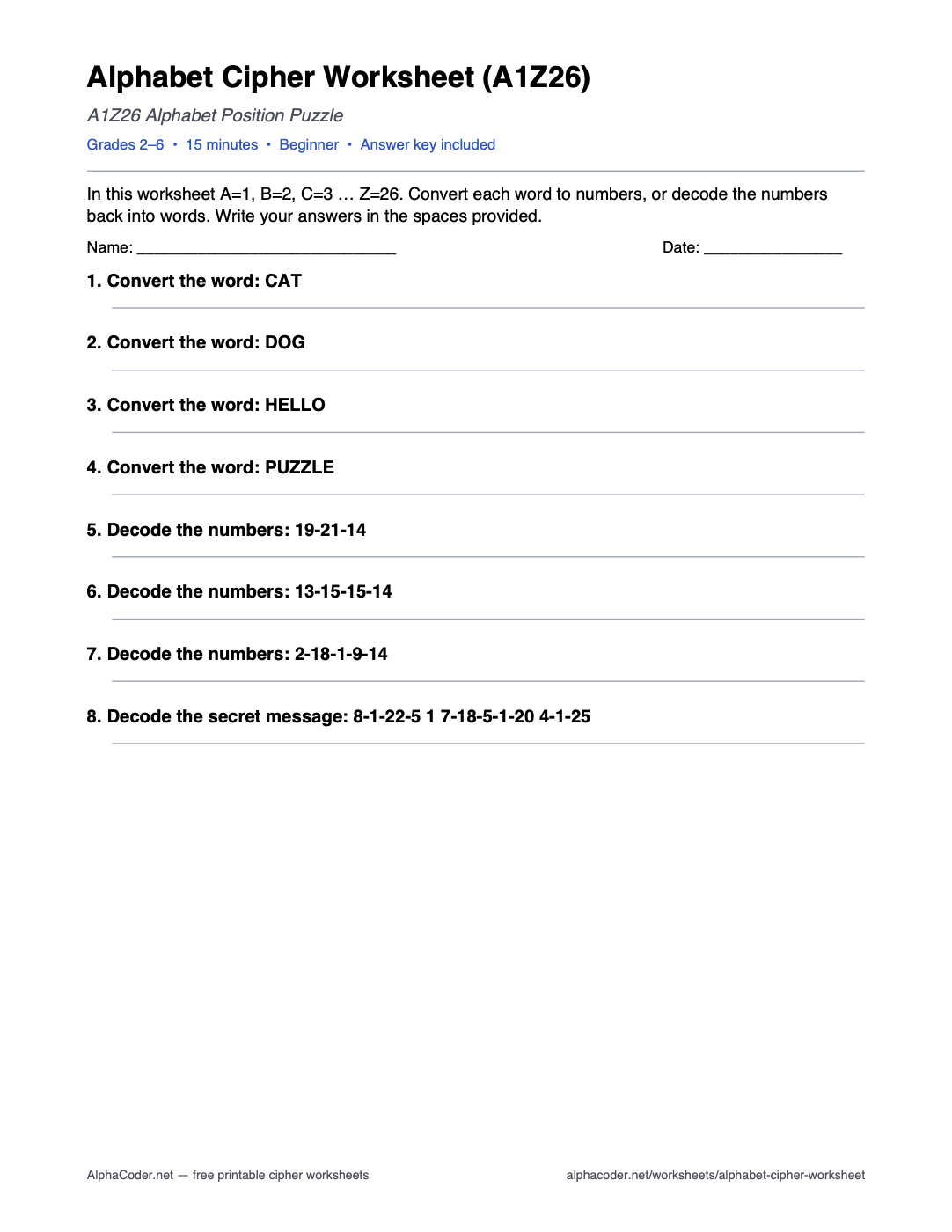
Practice alphabet positions with a printable worksheet
Grab a ready-to-print PDF with a matching answer key — no signup needed.
Written by Jack Shi. AlphaCoder tools process every conversion locally in your browser.