Creative Use Cases
Letters to Numbers for Tattoos — Cipher Ink Ideas & Designs
Cipher tattoos have surged in popularity as people look for meaningful, personal ink that carries a hidden message only they (or those who know the code) can read. The concept is straightforward: use a letters to numbers converter to transform a name, word, date, or phrase into a numeric sequence, then tattoo those numbers. The result is a piece of body art that looks elegant to everyone and carries deep personal significance for you.
This guide covers the most popular cipher styles for tattoos, walks through encoding examples, offers design tips from tattoo artists, and flags the most common mistakes to avoid before you commit to permanent ink.
Why Cipher Tattoos Work
A cipher tattoo solves a common dilemma: you want to honor a person, memory, or phrase, but you do not want the whole world to read it at a glance. Names tattooed in plain text can feel too exposed. Dates in standard format are immediately recognizable. But "12-15-22-5" is a private code that only reveals its meaning ("LOVE") to those who know the cipher.
Numeric cipher tattoos also age better than text tattoos because digits have simpler, bolder shapes than cursive or script fonts. They look clean at small sizes, work in any orientation (horizontal, vertical, wrapped), and complement both minimalist and elaborate tattoo styles.
Style 1: A1Z26 Number Cipher
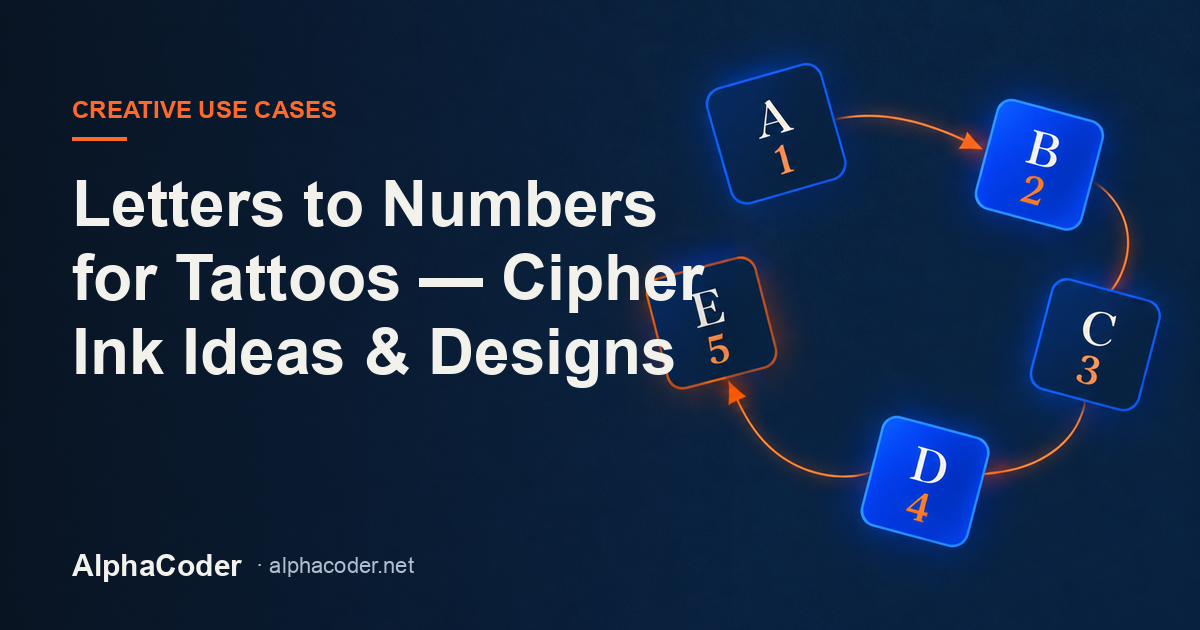
The A1Z26 cipher is the most popular choice for tattoos. Each letter equals its position in the alphabet: A=1, B=2, C=3, all the way to Z=26. Numbers are separated by dashes, dots, or spaces.
Use the A1Z26 cipher converter to verify your encoding instantly.
Encoding Examples
| Word/Name | A1Z26 Encoding |
|---|---|
| LOVE | 12-15-22-5 |
| MOM | 13-15-13 |
| HOPE | 8-15-16-5 |
| FAITH | 6-1-9-20-8 |
| BRAVE | 2-18-1-22-5 |
| FREE | 6-18-5-5 |
| GRACE | 7-18-1-3-5 |
Design Tips for A1Z26 Tattoos
- Separator choice matters: Dashes (12-15-22-5) look clean and modern. Dots (12.15.22.5) feel softer and more decorative. Spaces (12 15 22 5) are minimalist but can be ambiguous between "1 2" and "12."
- Font style: Typewriter or monospace fonts maintain consistent digit spacing. Script fonts look elegant but can make digits hard to read at small sizes.
- Placement: Wrist, inner forearm, collarbone, and ribcage are the most popular placements. Short words (3-5 letters) work on the wrist. Longer phrases suit the forearm or spine.
- Padding: Use two-digit formatting for consistency. Write "01" instead of "1" so every number has the same width: 12-15-22-05.
Style 2: Binary Code Tattoos
Binary tattoos convert each letter to its ASCII binary value: eight digits of 0s and 1s. The visual effect is dramatic, with dense rows of digits creating a band or block pattern. Use our binary to text converter to generate and verify binary encodings.
Binary Encoding Examples
| Letter | ASCII Value | Binary |
|---|---|---|
| L | 76 | 01001100 |
| O | 79 | 01001111 |
| V | 86 | 01010110 |
| E | 69 | 01000101 |
So "LOVE" in binary becomes: 01001100 01001111 01010110 01000101. That is 32 digits, which creates a substantial visual piece.
Design Tips for Binary Tattoos
- Use equal-width digits: Every 0 and 1 must be the same width, or the pattern looks uneven. Monospace fonts are essential.
- Band layouts: Wrap binary around the arm like a bracelet. Each byte (8 digits) occupies one segment, with small gaps between letters.
- Vertical stacking: Stack each letter's binary code in a column for a compact, grid-like design.
- Scale carefully: Binary tattoos need to be large enough for each digit to be legible. Tiny binary becomes an unreadable blob after a few years.
Style 3: Morse Code Tattoos
Morse code uses dots and dashes, which translate beautifully into tattoo art. Dots become small filled circles, and dashes become short horizontal lines. The result is an abstract, artistic pattern.
Verify your Morse encoding with the Morse code translator.
Morse Encoding for "LOVE"
- L: dot-dash-dot-dot
- O: dash-dash-dash
- V: dot-dot-dot-dash
- E: dot
Design Tips for Morse Tattoos
- Consistent sizing: Dashes should be exactly three times the width of dots. Gaps between elements within a letter should be one dot width, and gaps between letters should be three dot widths.
- Directional layouts: Morse works horizontally (reading left to right), vertically (top to bottom), or even spiraling around a wrist.
- Decorative additions: Some people thread Morse code through floral designs, heartbeat lines, or geometric patterns.
Style 4: Roman Numeral Ciphers
Roman numerals add a classical, timeless look. Convert each letter's alphabet position to Roman numerals: A=I, B=II, C=III, D=IV, E=V, and so on. This style works particularly well for dates and single words.
Roman Numeral Examples
| Letter | Position | Roman |
|---|---|---|
| L | 12 | XII |
| O | 15 | XV |
| V | 22 | XXII |
| E | 5 | V |
"LOVE" becomes: XII . XV . XXII . V. The dots serve as separators and add visual rhythm.
Style 5: Coordinate and Date Disguises
A more subtle approach encodes your message as GPS coordinates or calendar dates. For instance, using A1Z26 values formatted as coordinates: "LOVE" = 12.15, 22.05 (looks like a GPS location). Or as dates: 12/15, 22/05 (looks like two calendar dates).
This technique adds an extra layer of mystery because the tattoo does not look like a code at all. It looks like a meaningful place or date.
Combining Cipher Styles
Many tattoo designs combine multiple encoding styles in a single piece. For example, a person's name in A1Z26, their birth date in Roman numerals, and a personal motto in Morse code, all arranged in a vertical stack or circular mandala.
The key to multi-cipher tattoos is visual consistency. Use the same ink weight and spacing principles throughout, even when mixing systems. A skilled tattoo artist can unify different encoding styles through layout and font choices.
Common Mistakes to Avoid
Cipher tattoos are permanent. Mistakes are expensive and painful to fix. Here are the most frequent errors people make.
- Miscounting letter positions: The most common error. People frequently miscount letters past J (the 10th letter). Always verify with a digital converter, never rely on counting on your fingers.
- Inconsistent separators: Mixing dashes and dots within the same tattoo breaks the visual pattern and creates ambiguity. Choose one separator and stick with it.
- Not accounting for case: In A1Z26, upper and lowercase letters have the same values. But in ASCII and binary, uppercase and lowercase have different codes. "L" (76) and "l" (108) are different in binary.
- Forgetting spaces: If your message has multiple words, decide how to represent the word boundary. Common choices: larger gap, a slash (/), or the number 0.
- Too small: Tiny digits blur together as skin ages. Minimum recommended size is about 8mm per character for long-term legibility.
- Not getting a proof: Always bring a printed proof showing your encoded message to the tattoo appointment. Have the artist match it character by character before inking.
Pre-Tattoo Checklist
Before your appointment, verify everything with this checklist.
- Encode your message using a digital converter (not by hand).
- Decode the result back to text to confirm it matches your original message.
- Have a friend independently decode your numbers without telling them the original message.
- Print the final sequence at the exact size and font you want tattooed.
- Bring the printed proof to your artist and compare character by character.
- Ask your artist to do a temporary placement (stencil) so you can check orientation and size on your skin before committing.
Verify before you ink: Use the A1Z26 Converter to encode and decode your message. Copy the result, paste it back in decode mode, and confirm it matches perfectly. Free, instant, and zero risk.
Frequently Asked Questions
What is the most popular cipher style for tattoos?
The A1Z26 number cipher (A=1, B=2, Z=26) is the most popular choice for cipher tattoos. It produces clean, compact number sequences that look elegant as ink. The numbers are easy to verify, small enough for discreet placements, and universally decodable by anyone who knows the basic alphabet position system. A close second is Morse code, which creates visually striking dot-dash patterns.
How do I convert a name to numbers for a tattoo?
Replace each letter with its position in the alphabet: A=1, B=2, C=3, through Z=26, and separate with dashes or dots.For example, "MOM" becomes 13-15-13. Always verify your encoding using a digital converter rather than counting manually. Double-check by decoding the numbers back to letters. Print the final result and bring it to your tattoo appointment as a reference proof.
Can I use binary code for a tattoo?
Yes, binary tattoos create visually dramatic designs with rows of 0s and 1s.Each letter converts to its 8-digit ASCII binary value. "LOVE" in binary is 01001100 01001111 01010110 01000101. Binary works best as arm bands, stacked columns, or wrapped text. Use a monospace font and ensure the tattoo is large enough for each digit to remain legible as your skin ages.
What are common mistakes with cipher tattoos?
The three most common mistakes are miscounting letter positions, using inconsistent separators, and not verifying with a digital tool before the appointment. People frequently miscount letters in the middle of the alphabet (K through Q are the usual trouble zone). Mixing dashes and dots as separators creates visual chaos and decoding ambiguity. The simplest prevention: encode your message with an online converter, decode it back, and print a verified proof to bring to the artist.
Written by Jack Shi. AlphaCoder tools process every conversion locally in your browser.