Printable Morse Code Chart
A free, printable International Morse code chart covering every letter A–Z and the digits 0–9. A dot (·) is a short signal and a dash (–) is a long one; leave one space between letters and three between words. Download the clean PDF or SVG below, or read the full table on this page.
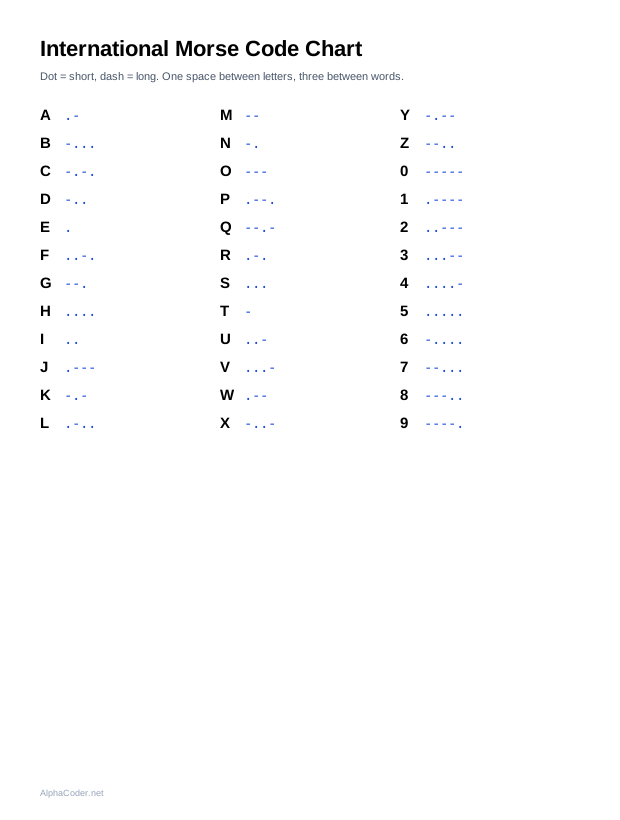
Full Morse code table
| Character | Morse code |
|---|---|
| A | .- |
| B | -... |
| C | -.-. |
| D | -.. |
| E | . |
| F | ..-. |
| G | --. |
| H | .... |
| I | .. |
| J | .--- |
| K | -.- |
| L | .-.. |
| M | -- |
| N | -. |
| O | --- |
| P | .--. |
| Q | --.- |
| R | .-. |
| S | ... |
| T | - |
| U | ..- |
| V | ...- |
| W | .-- |
| X | -..- |
| Y | -.-- |
| Z | --.. |
| 0 | ----- |
| 1 | .---- |
| 2 | ..--- |
| 3 | ...-- |
| 4 | ....- |
| 5 | ..... |
| 6 | -.... |
| 7 | --... |
| 8 | ---.. |
| 9 | ----. |
Morse code punctuation
The ITU-R M.1677-1 standard defines the marks in the first table. The second table lists marks that are widely used but are not in that standard, so a receiver trained only on the ITU list may not recognize them. The printable chart above covers letters and digits only.
| . | .-.-.- |
| , | --..-- |
| : | ---... |
| ? | ..--.. |
| ' | .----. |
| - | -....- |
| / | -..-. |
| ( | -.--. |
| ) | -.--.- |
| " | .-..-. |
| = | -...- |
| + | .-.-. |
| @ | .--.-. |
| É (e-acute) | ..-.. |
| ! | -.-.-- |
| & | .-... |
| ; | -.-.-. |
| _ | ..--.- |
How to read Morse code
Each letter is a unique sequence of dots and dashes. The most common letter, E, is a single dot; T is a single dash. Timing is what separates words: a gap of one dot-length sits between the parts of a letter, three between letters, and seven between words.
Want to hear it or convert a message? Use the Morse code translator or practise with the Morse code worksheet.